
Market Insights
How Gold Is Mined and Refined: From Earth to Pure Bullion
Jun
Most people who buy gold coins or bars have never stopped to wonder where that gleaming metal actually came from before it arrived in a vault or a display case. The journey from raw ore buried deep underground to a polished, investment-grade bar is long, technically demanding, and genuinely fascinating. Understanding that process can give you a deeper appreciation for why gold holds the value it does — and why producing new supply is never as simple as just digging faster.
How Gold Forms in the Earth
Gold does not form the way most people imagine. It is not created inside the planet — scientists believe most of the gold accessible to us was delivered by asteroid impacts billions of years ago, after Earth’s crust had already solidified. Over vast stretches of geological time, hydrothermal fluids — superheated water carrying dissolved minerals — pushed gold through cracks and fissures in rock, depositing it in veins and concentrations we now call ore bodies.
These deposits come in two main varieties. Primary deposits, also called lode deposits, are veins of gold locked inside hard rock formations. Placer deposits occur when erosion breaks apart primary deposits over thousands of years and water carries the gold downstream, where it settles in riverbeds and gravel beds. The famous gold rushes of the 19th century — California in 1848, Australia in 1851, the Klondike in 1896 — were largely driven by placer gold that prospectors could recover with pans and sluices. Today, the vast majority of commercial gold production targets primary hard-rock deposits.
Modern Gold Mining Methods
Commercial gold mining today is an industrial-scale operation. Open-pit mining is the most common method used when an ore body sits relatively close to the surface. Enormous machines strip away layers of earth and rock to expose the ore below, which is then blasted, loaded onto massive haul trucks, and transported to a processing facility. Open-pit mines can cover hundreds of acres and reach depths of more than a thousand feet.
Underground mining is used when ore bodies sit too deep for surface excavation to be practical. Workers and equipment travel through a network of shafts and tunnels to reach the ore, which is drilled, blasted, and hauled to the surface in smaller quantities. Underground mining is more expensive per ton of ore processed, but it becomes necessary when the richest gold concentrations are buried far beneath the surface.
One important reality of gold mining is just how little gold is actually present in the ore. Many large commercial operations process ore that contains only a few grams of gold per ton of rock. Moving and processing millions of tons of material to recover a relatively small amount of gold is exactly why mining is capital-intensive and why newly mined gold carries real production costs.
Extracting Gold From Ore
Once ore reaches a processing facility, the goal is to separate the gold from everything else. The most widely used industrial method is cyanide leaching, sometimes called the cyanidation process. Crushed ore is mixed with a dilute cyanide solution, which bonds chemically with gold particles and dissolves them away from the surrounding rock. The gold-bearing solution is then collected and processed further to pull the gold out of the liquid.
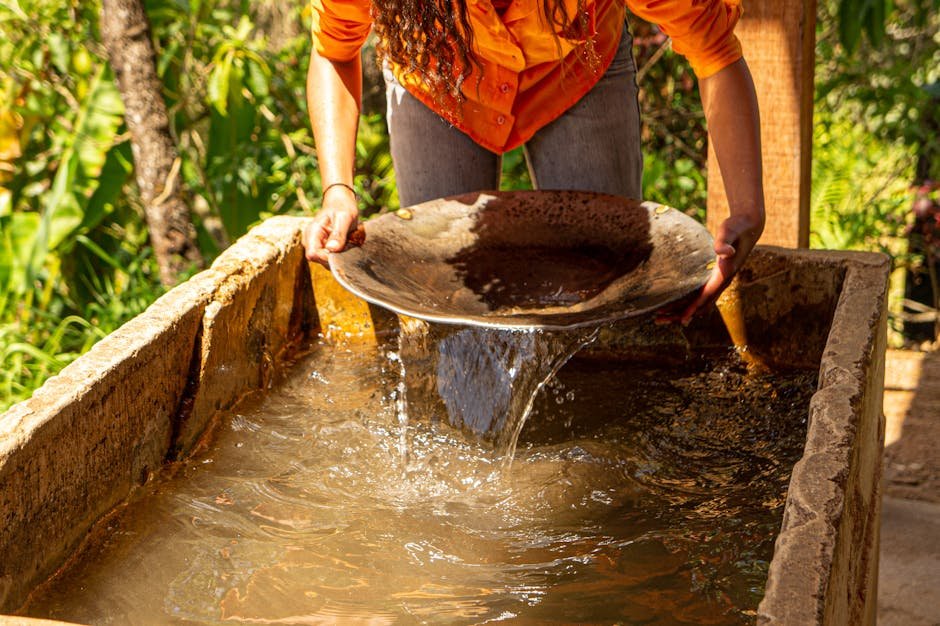
An older but still relevant technique is gravity concentration, which works on the same basic principle as a gold pan — gold is much denser than most other minerals, so equipment like shaking tables and centrifuges can physically separate it from lighter material. Many modern operations use gravity concentration as a first step before cyanide leaching to capture the coarsest gold particles quickly.
The result of this extraction stage is not pure gold. What comes out is a crude mixture called doré — a rough alloy of gold and silver, along with trace amounts of other metals. Doré typically contains anywhere from 60 to 90 percent gold depending on the deposit. Getting from doré to the pure, investment-grade metal you see in a coin or bar requires one more critical stage.
The Refining Process
Refining is where raw doré is transformed into the high-purity gold that meets international standards for bullion products. There are two primary refining methods used at large-scale refineries. The first is the Miller process, in which chlorine gas is bubbled through molten doré. The chlorine reacts with silver and base metals, pulling them out of the melt and leaving behind gold with a purity of about 99.5 percent.
The second method, the Wohlwill process, takes refinement even further using electrolysis. A bar of partially refined gold is suspended in a solution of gold chloride and an electric current is passed through it. Gold dissolves off the bar and re-deposits on a cathode at purities of 99.99 percent — the standard marked as .9999 fine that you see on many investment-grade coins and bars. Many government mints and major refineries use a combination of both processes to achieve maximum purity at scale.
From Refinery to Bullion Product
After refining, gold is poured or pressed into the finished forms familiar to buyers. Cast bars are made by pouring liquid gold into molds and allowing it to cool, producing the slightly rough-textured bars often associated with large institutional holdings. Minted bars are cut from a flat sheet of refined gold and stamped under high pressure, giving them the sharp edges and polished faces you see on premium retail products.
Coins go through a more involved minting process. Refined gold is rolled to precise thickness, blank discs are punched out, and each blank is struck with hardened dies that imprint the design under tremendous pressure. Government-issued bullion coins from mints such as the U.S. Mint, the Royal Canadian Mint, and the Perth Mint carry a guaranteed gold content and legal tender status, backed by their respective governments.
Every bar and coin that arrives at a reputable dealer has traveled through each of these stages — from ore body to refinery to mint to vault. That chain of production, quality control, and assay verification is part of what gives physical gold its credibility as a store of value.
Why This Journey Matters to Buyers
Understanding how gold is produced helps you ask better questions when you buy. Look for products from accredited refiners and government mints, verify the stated purity and weight, and buy from dealers who source from reputable supply chains. When you are ready to shop for coins or bars at current spot price, Absolute Bullion offers a straightforward selection of verified bullion products with transparent pricing.
The enormous effort required to bring gold from the ground to investment-grade form is a reminder that this metal is genuinely scarce. New supply cannot be conjured quickly or cheaply, which is part of why gold has maintained its appeal across centuries and cultures. Whether you are buying your first ounce or adding to an existing position, knowing what goes into producing that metal adds real meaning to what you hold in your hand. Visit absolutebullion.com to explore current inventory and take the next step with confidence.
