
Market Insights
The History of Currency Debasement: How Governments Erode Your Wealth
Jul
Few economic forces have done more quiet damage to ordinary people than currency debasement. It does not announce itself loudly. It works slowly, steadily, and often invisibly — shrinking the purchasing power of the money in your wallet and the savings in your bank account. Understanding how governments have debased their currencies throughout history is not just an academic exercise. It is a practical lesson in why many people choose to hold physical gold and silver as a long-term store of value. The pattern repeats across centuries and civilizations, and recognizing it puts you in a stronger financial position.
What Is Currency Debasement?
Currency debasement happens when a government or monetary authority reduces the real value of its currency. In ancient times, this was done physically — rulers would mix cheaper metals like copper or tin into gold and silver coins while keeping the face value the same. The coin looked similar but contained far less precious metal. Merchants and citizens eventually caught on, prices rose to compensate, and the purchasing power of those coins fell.
In the modern era, the method changed but the result did not. Today’s governments debase currency by printing more money — technically called monetary expansion or quantitative easing. When more units of currency chase the same amount of goods and services, each unit buys less. That is inflation, and it is the modern equivalent of shaving silver off a Roman coin. The tool changed; the erosion of wealth did not.
Ancient Rome: The Textbook Case
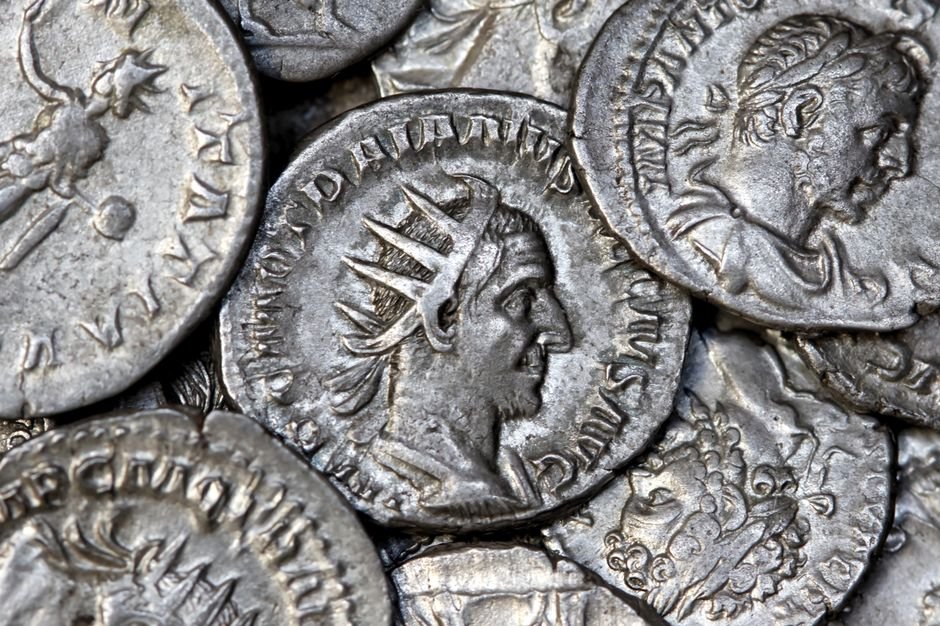
The Roman Empire offers one of history’s most thoroughly documented examples of currency debasement. The Roman silver coin known as the denarius was nearly pure silver when it was introduced. Over the following centuries, emperors facing mounting military costs, civil wars, and administrative expenses progressively reduced the silver content of the coin. By the third century AD, what had once been nearly pure silver contained only a small fraction of that metal.
The consequences were predictable. Roman citizens and merchants recognized the devalued coins and demanded more of them for the same goods. Prices across the empire rose sharply. The government responded by issuing even more debased currency to cover its expenses, which only made inflation worse. Historians credit this monetary crisis as one of the contributing factors to the empire’s eventual decline. The Roman economy never fully stabilized after the silver content of its currency was gutted.
What makes the Roman example so instructive is how long it took for most ordinary people to realize what was happening. The debasement unfolded over generations, not months. Those who held real silver — the actual metal, not the coins — preserved their purchasing power far better than those who trusted the government’s currency at face value.
Medieval Europe and the “Great Debasement”
The Roman Empire was not alone. Medieval European monarchs regularly manipulated their coinage to generate revenue without raising taxes directly. In England, King Henry VIII oversaw what historians call the Great Debasement between 1544 and 1551. The silver content of English coins was dramatically reduced while their face value remained the same. The Crown effectively taxed its citizens through inflation rather than through a formal levy.
The results were immediate and damaging. Prices rose sharply across England. Merchants and trade partners abroad quickly identified the reduced silver content and discounted English coins accordingly. The economy suffered significant disruption, and it took years of reform under later rulers to restore confidence in English coinage. The episode is a clear early modern example of how currency manipulation shifts wealth from citizens to the state.
The 20th Century and Paper Money
The shift away from metal-backed currencies accelerated throughout the twentieth century. In the United States, the dollar was formally tied to gold under the Bretton Woods system established after World War II. Other countries pegged their currencies to the dollar, and the dollar itself was redeemable in gold at a fixed rate. This system imposed discipline on money creation because governments could not print money beyond what their gold reserves could support.
That discipline ended in 1971 when President Nixon suspended the dollar’s convertibility to gold — an event now commonly called the Nixon Shock. From that point forward, the U.S. dollar became a purely fiat currency, meaning it was backed only by government decree and public confidence rather than any physical commodity. With that constraint removed, the money supply could — and did — expand far more rapidly. The consumer price index, which tracks the cost of everyday goods, has risen substantially in the decades since, reflecting the cumulative erosion of the dollar’s purchasing power.
The post-2008 era and particularly the years following 2020 brought an acceleration of money creation on a scale rarely seen in peacetime. Central banks around the world expanded their balance sheets dramatically. The inflationary pressures that followed reminded many economists and everyday savers that the lessons of ancient Rome and Henry VIII’s England had not been repealed — only postponed.
How Gold and Silver Have Responded Historically
Throughout every episode of currency debasement, physical gold and silver have served as anchors. Because they cannot be printed, duplicated, or conjured by a government decree, their supply grows only slowly through mining. When paper currencies lose value, it often takes more of that paper to purchase the same ounce of gold or silver — which is another way of saying the metals held their purchasing power while the currency did not.
This is not a modern observation. It was understood by merchants in ancient Rome, by Elizabethan traders following England’s Great Debasement, and by investors after the Nixon Shock. Physical precious metals represent a form of savings that governments cannot easily dilute. That is precisely why they have served as money and stores of value across virtually every culture and era in recorded history.
What You Can Do to Protect Your Purchasing Power
Understanding history is only useful if it informs action. Here are practical steps worth considering if you are concerned about the long-term effects of currency debasement:
- Start with physical metal. Coins and bars you can hold are not subject to counterparty risk the way financial instruments are.
- Focus on recognized products. Gold and silver coins from major government mints — such as American Eagles or Canadian Maple Leafs — are widely recognized and easy to trade.
- Buy consistently over time. Purchasing small amounts regularly, sometimes called dollar-cost averaging, reduces the impact of short-term price swings.
- Store securely. A home safe or a professional vault service are both worth considering depending on the size of your holdings.
- Stay informed on pricing. Spot prices for gold and silver change daily. Check absolutebullion.com for current pricing before you buy.
No single asset eliminates all financial risk, and precious metals are no exception. But they have a track record as stores of value that stretches back thousands of years — longer than any government or currency in existence today.
The history of currency debasement is, at its core, a story of trust broken slowly and wealth transferred quietly from savers to those who control the money supply. Gold and silver have outlasted every debased currency ever issued. If you are ready to explore physical precious metals as part of a balanced financial strategy, visit Absolute Bullion to browse current inventory and live pricing. Taking even a small step toward tangible assets is a decision that history consistently vindicates.
